
Last week, I wrote about “raising the floor” for boring operational work. But it also got me thinking about something I’m seeing with clients that feels related but different.
Raise the floor, not the ceiling
Most of the conversation around AI is still about optimization - doing the standard thing better, faster, cheaper. And that matters. But there’s another pattern I keep noticing across totally different industries: companies that want to throw out the playbook entirely.
It’s not for ego or the sake of being different. But because they have ideas about how their industry could work better, and how AI can finally make those ideas real. It’s the same disruption mindset we’ve seen with venture-backed SaaS over the years, but now applied outside of tech.
So this week’s post is about that: when AI’s real value isn’t optimizing the playbook others succeeded on, but helping you to compete on how uniquely you operate.
Enjoy!
~ Harry
So I’ve been working with a weird mix of companies lately. Executive recruiting. Non-profits. Asset managers. Real estate firms. CPG brands. Professional communities.
From the outside, these businesses have nothing in common. Different industries, different business models, different customers.
It’s the kind of portfolio that makes it really hard to answer the “so what’s your niche?” question. Still working on it…
But there’s one common thread: they all have the same problem. And the same ambition to solve it.
It’s not that they don’t know how to run their business. They know the industry playbook. They’ve seen how everyone else operates. They understand the standard approach.
The problem is that they want to operate differently. And until now, they couldn’t.
The Playbook Prison
Every industry has its playbooks. The way things are done. The standard operating procedures that emerged because they worked, got copied, and became the default.
In B2C, you broadcast messages because personalization doesn’t scale. In sales, you segment accounts by size because small teams can’t give enterprise-level attention to everyone. In recruiting, you follow a funnel because manual research on every candidate is impossible. In nonprofits, you operate within certain constraints because the alternatives require infrastructure you can’t afford.
They exist for real reasons. They’re not bad. They are things like resource constraints, human limitations, and an economic reality that comes with running any operation.
But almost every client I work with has ideas about how their industry could work better. Not revolutionary moonshot ideas. Just “what if we could do this part differently?”
What if we could treat every customer like an enterprise account instead of broadcasting? What if we could research every prospect as deeply as we research our biggest deals? What if we could operate our nonprofit more like a high-velocity startup without losing our touch?
They’re operational hypotheses. Ways of working that would create genuine differentiation if they were actually achievable.
And until recently, they weren’t unless you had large amounts of capital and a pretty high risk tolerance.
Let me explain what I mean.
What AI Actually Changes
I will say that I think we’re having the wrong conversation about AI and business.
Most of the discussion is about making existing playbooks better. Using AI to execute the standard approach faster, cheaper, more efficiently. That’s fine. That’s the “raise the floor” work I wrote about last time.
But there’s something else happening that’s I’m finding even more interesting: AI is making it possible to compete on how you operate, not just on what you do.
Let me give you some examples of what I mean.
A B2C company that can now give every customer the kind of individualized attention that used to be reserved for enterprise accounts. Not through better segmentation. Through actual personalized research, understanding, and communication at scale.
A sales team that treats what would normally be commercial accounts like enterprise opportunities. Full research. Deep context. Strategic approach. Because AI handles the research that used to require an army of SDRs (and immense venture funding).
A nonprofit that can move at startup speed and measure their impact for future funding because AI handles the operational infrastructure that normally requires dedicated teams. They’re moving faster because they’re not trapped by the nonprofit playbook.
The lazy thinking is that they are simply applying automations and workflows to standard processes. Instead, they are investing time and resources into finding fundamentally different ways of working/operating that become possible when you remove constraints created by the original playbook.
But not everyone is thinking about AI this way. When I look at how companies are actually approaching this, I see three distinct patterns.
The Split I’m Seeing
Here’s how I’d describe what I’m actually encountering in the market.
On one end, there’s the garbage. The cheaply produced AI ads. The spammy outreach. The SaaS tools adding AI features that do nothing except show they needed to do something AI-related to keep investors happy. The content engines polluting our comment sections.
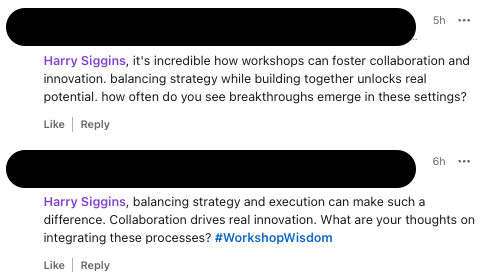
Instant block. Report as spam so fast.
Then there’s the middle ground - and this is where most companies should start. Taking what works and doing it better with AI. Your current operations, your proven SOPs, your effective playbook, just executed with more consistency, speed, and scale. This is the “raise the floor” work. It matters. You should probably do this first.
Raise the floor, not the ceiling
But the companies I keep thinking about are doing something different. They’re using AI to test hypotheses about how their industry could work better. They’re applying it to operational approaches that weren’t possible before, and AI gives them a chance to validate whether their contrarian ideas actually create value.
This is where the most interesting conversations are happening. And it’s happening with smaller teams, not enterprise companies stuck in legacy processes.
Which brings me back to that question about my niche.
Why This Matters More Than Optimization
The companies I work with are similar because they all want to operate in ways that their industry doesn’t. They’re asking “what if the standard way isn’t actually the best way?”
And that question used to be theoretical. You could have opinions about better ways to operate, but you were constrained by what was actually executable with human teams and traditional tools.
AI changes that calculation. Your competitive advantage isn’t just your product anymore. It’s not your positioning. It’s not even your team (though that still matters).
It’s how you operate. How you do the work. How you engage with customers. How you deliver value to them.
It won’t be for everyone, but it will be for those in your market who are also screaming for a change from the other side.
The Foundation Problem
But the thing is, you can’t skip straight to tier 3 work immediately.
If your current operations are chaotic, if your systems don’t reflect reality, if your team is drowning in debt - throwing out the playbook doesn’t help. It makes things worse.
You need the foundation first. The boring operational discipline. The pieces in place that help your work function consistently. The baseline effectiveness that lets you raise your floor.
Because differentiation without operational sanity is just a mess with better marketing.
The companies I see making this work are doing both. They’re using AI to handle the operational basics so their team members can focus on the unique approach that creates actual value. The boring stuff gets automated. The differentiated stuff gets attention.
It’s not either/or. It’s sequential. Foundation first, then differentiation.
What Changes
If AI makes it possible to compete on operational approach, a lot changes.
Industry best practices become less important. The “this is how it’s always been done” argument loses weight. The playbook becomes a starting point for questioning instead of blindly copying.
Smaller teams can operate in ways that used to require enterprise resources. You don’t need a massive SDR team to do enterprise-level research. You don’t need huge customer success organizations to give individualized attention. You don’t need extensive infrastructure to move fast.
And competition starts to look different. It’s going to be more about who has the operational creativity to do things differently when different is actually better.
The biggest questions around AI for any company should be less about the tech and more towards using it for competitive advantage their customers would care about:
What could you do differently for your customers if you could? And can AI make that testable?